The World Came to Dubai: Inside Arabian Travel Market 2026
Reporting from the floor at Arabian Travel Market 2026, Dubai World Trade Centre, 14 to 17 September. AURA 919 is on site supporting exhibitor stands and graphics.
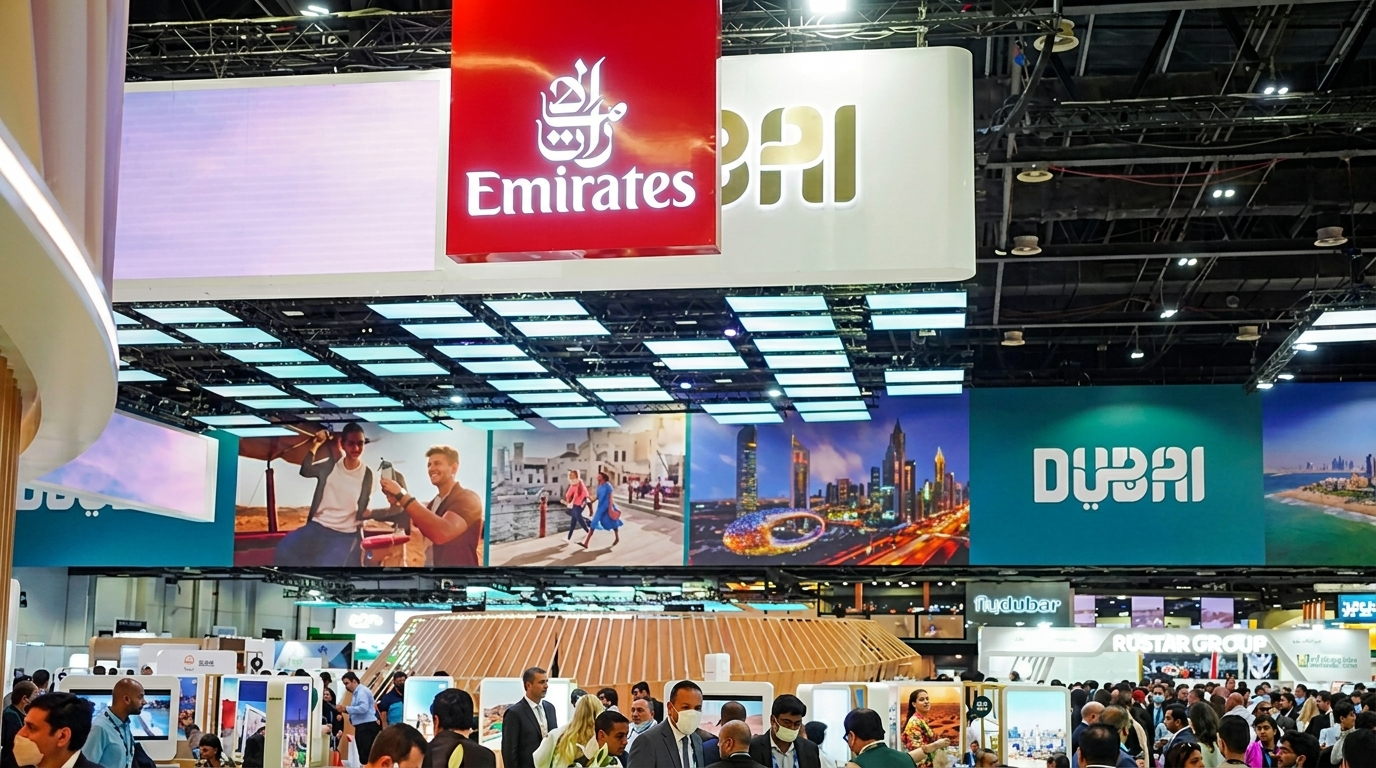
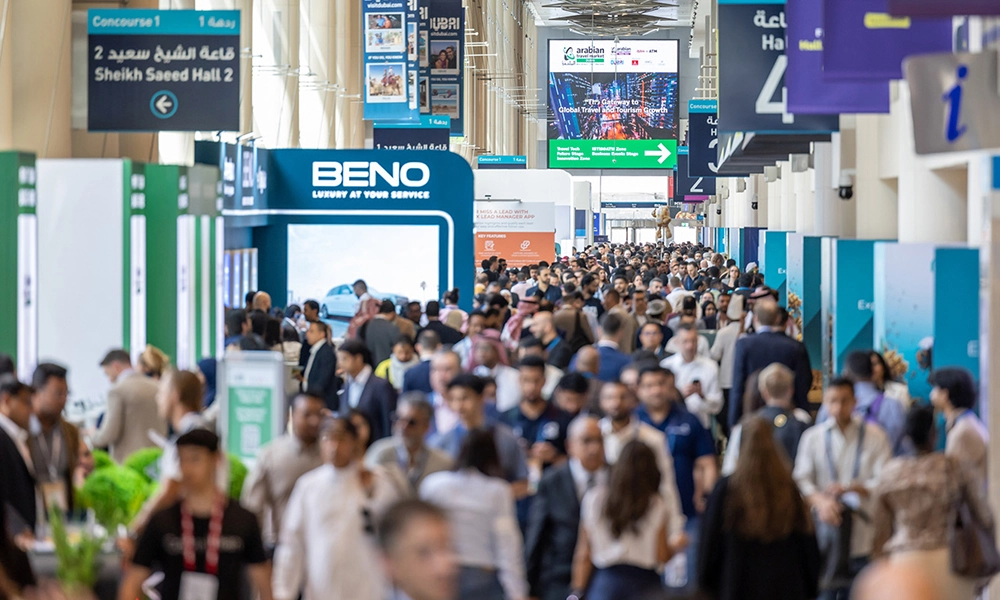
By late morning on Monday the aisles of Sheikh Saeed Hall were already full, and somewhere between the Emirates stand and the Dubai pavilion a crowd had begun to gather, the way crowds do when something is about to happen.
His Highness Sheikh Mohammed bin Rashid Al Maktoum, Vice President and Prime Minister of the UAE and Ruler of Dubai, was touring the 33rd Arabian Travel Market.
He has done it before. He toured the 30th edition in 2023, and the 32nd in 2025, stopping at the Emirates and flydubai pavilions and the Emirates Tourism Council stand. His son, His Highness Sheikh Hamdan bin Mohammed bin Rashid Al Maktoum, Crown Prince of Dubai, toured the 31st edition in 2024.
It has become a ritual, and rituals in this city are rarely ceremonial. They are signals.
And the signal this year is unusually clear. Emirates 24|7 reported strong visitor demand from the opening hours, as more than 55,000 participants from 166 countries began arriving. What almost nobody outside this industry knows is how much work went into making that morning look effortless.
The City That Kept Its Date
Arabian Travel Market 2026 was originally scheduled for 4 to 7 May, then confirmed for 14 to 17 September after what organiser RX Global described as consultations with exhibitors and global travel industry stakeholders. Danielle Curtis, Regional Portfolio Director for the UAE, framed the decision around allowing exhibitors, buyers and visitors to maximise their participation.
One thing never changed. The venue.
Dubai World Trade Centre held the floor plan, held the halls and held the commitment to every exhibitor who had already signed. The date moved. The city did not.
That sentence took four months to earn, and it was earned in warehouses and print rooms rather than on stages.
Consider what a date change actually costs the people who build these floors, because almost nobody outside the industry does.
A national pavilion at this show is designed six to nine months in advance. Structures are fabricated, then crated, then held. Freight is booked against a fixed window. Labour is scheduled. Storage is contracted by the month. Graphics are printed with dates, campaign lines and seasonal messaging baked into the artwork.
Move the show once and every one of those contracts is renegotiated. Move it twice and you are storing a completed pavilion through a Dubai summer, re-quoting freight against a different shipping season, rebooking crews who have taken other work, and reprinting graphics that said May.
Multiply that across 1,400 exhibitors and 48 pavilions.
Exhibitors do not commit that kind of budget and logistics to a city they are uncertain about. They commit it to a market they intend to be in for the next decade.
And almost every one of those 1,400 companies came anyway.
That is the thing worth recording about ATM 2026. The size of this floor is, in itself, a statement of confidence in Dubai, and the floor looked on Monday morning exactly as though the work behind it had been effortless.
Governments and Global Tourism Bodies Opened the Programme
The Global Stage opened with a session titled Building A Resilient Industry Through Collaboration.
It was a well-chosen title. On the panel: His Excellency Abdulla bin Touq Al Marri, UAE Minister of Economy and Tourism; Her Excellency Shaikha Al Nuwais, Secretary-General of UN Tourism, who delivered the welcome address; Fatima Jaafar Al Sairafi, Bahrain’s Minister of Tourism; and Apostolos Tzitzikostas, European Commissioner for Sustainable Transport and Tourism.
The connectivity picture behind that conversation is strong. The UAE confirmed full resumption of air traffic operations on 2 May, with Qatar, Bahrain and Kuwait airspace also fully open.
Emirates has restored 96 per cent of its global network, operating to 138 destinations across 73 countries with more than 1,300 weekly frequencies. Etihad Airways, flydubai and Qatar Airways are all continuing to restore schedules.
Gulf News described the mood on the floor as noticeably hopeful. From where we were standing it read as something firmer than hope. It read as confidence that had already been paid for.
Five Halls, One City
The scale of this show is difficult to convey in a single number, so here is the footprint instead.
Arabian Travel Market 2026 occupies Halls 1 to 8, the Pavilion, Sheikh Saeed Halls 1 to 3, Trade Centre Arena, and Za’abeel Halls 2 to 3, according to the DWTC event listing.
That is five distinct venue zones operating simultaneously. Each with its own rigging plan, its own loading access, its own build schedule and its own crew. For anyone who works install weeks, it is the largest single coordination exercise on the Dubai calendar.
Emirates 24|7 reported visitors arriving before the official opening while organisers completed final preparations. That sentence covers a great deal of work.
Travel 2040 Arrived Early
The theme of this edition is Travel 2040: Driving New Frontiers Through Innovation and Technology, and the programme did not treat that as a distant horizon.
The Future Stage opened with Dr Marwan Al Zarouni, CEO of AI at the Dubai Department of Economy and Tourism and CEO of the Dubai Blockchain Center.
His argument, as reported by Gulf News, was structural rather than promotional. Artificial intelligence is now defining how travel systems are designed and operated, he said, and the industry should design those systems around desired outcomes from the outset instead of optimising bookings, check-ins and service as isolated touchpoints.
He described a shift from reactive operations to predictive decision-making, capable of forecasting demand, optimising capacity and personalising experiences in real time. Dubai already runs an AI-powered itinerary planner and mobile hotel check-in, and has embedded AI into the ten-year D33 Economic Agenda.
His caveat mattered more than his examples. The value of AI in travel depends on connected, high-quality data across aviation, hospitality, mobility and attractions. Disconnected systems limit what it can do.
Alongside that sits the largest structural addition of the year. ATM Travel Tech makes its debut as a dedicated co-located show, with more than 180 exhibitors from 30 countries across two halls, anchored by an 850 square metre Tech and Innovation Hub covering AI, VR and AR, robotics, fintech and green technology.
More than 80 sessions run across the Global Stage, Future Stage and Experience Hub over four days, featuring over 210 speakers, with senior representation from Sabre, Trip.com, Tripadvisor, Wego, MakeMyTrip, RateGain and Visa.
Forty-Eight Pavilions, Forty-Eight Arguments
Here is what most coverage of a travel trade show misses.
A destination pavilion is not an exhibition stand with a flag on it. It is a country making an argument about itself, in three dimensions, to an audience that has seen every other country make the same argument that morning.
Dubai’s stand, led by the Department of Economy and Tourism, carries more than 115 co-exhibitors from the emirate’s public and private sectors, alongside Dubai College of Tourism and Dubai Sustainable Tourism. It also carries something less usual. With support from Dubai Culture, work by Emirati artist Mariam Abbas sits on the stand, and visitors can sample Karam Coffee, Estekanah Chai and Camelicious, alongside the newly published Emirati cuisine guide Salt and Sand.
That is a destination that has understood something. Brochures are downloadable. Coffee is not.
Sharjah arrived with an entirely new Visit Sharjah pavilion, led by the Sharjah Commerce and Tourism Development Authority, bringing more than 30 government and private-sector entities under one structure, from museums and heritage bodies to the Sharjah International Marine Sports Club and Air Arabia. The design is experience-led, combining the emirate’s cultural and natural identity with digital interpretation.
The Department of Culture and Tourism Abu Dhabi and Visit Maldives Corporation carry two of the other largest pavilions on the floor, and Saudi Arabia returns with one of the show’s most visible national presences.
Forty-eight of these. Each designed, approved, fabricated, freighted, stored for four extra months, and installed in a compressed window.
The Airlines Filled Sheikh Saeed Hall
Emirates occupies its traditional position in Sheikh Saeed Hall, where visitors have queued in previous editions to sit in Boeing 777 business class seats on the stand itself. The airline now operates to 138 destinations across 73 countries, at 96 per cent of its global network, with more than 1,300 weekly frequencies.
The stand itself carries the brand’s familiar cue overhead, “Don’t Just Fly, Fly Better,” beneath a curved ceiling structure that has become one of the most photographed points on the floor.
On its own channels, Emirates confirmed it is using this year’s show to reveal its next-generation Premium Economy seat ahead of introduction, alongside a week of partnership announcements expected across the four days.
Etihad Airways, flydubai and Air Arabia are all present, alongside Qatar Airways, whose stand sits close to the Qatar Tourism presence and continues to position Doha as a connecting hub between Europe, Africa and Asia.
The conversations on those stands are about network expansion, new routes and fleet growth. Dubai’s position as a global aviation hub is not being defended here. It is being extended.
That, more than any panel, is what the opening day actually sounded like.
The Hotel Groups Brought Growth Plans, Not Just Brochures
Aviation tells one half of the connectivity story. Hospitality tells the other, and the region’s hotel groups used this year’s show to talk about where they are building next rather than simply where they already operate.
Rotana, one of the Gulf’s largest hospitality companies, used ATM to launch Edge by Rotana, a new brand extending the group’s portfolio. Guy Hutchinson, Rotana’s Chief Operating Officer, has led the addition of 28 new hotels across 13 markets and the introduction of a franchise model, alongside new sales offices in Paris, Milan, Amsterdam and Istanbul aimed at driving demand from those source markets back into the Gulf.
Rove Hotels, the value-led joint venture between Emaar Hospitality Group and Meraas, had its own presence on the floor. Paul Bridger, Rove’s Chief Operating Officer, has overseen the brand’s expansion since its first opening in Downtown Dubai in 2016, with new properties continuing to open across the past year.
IHG Hotels and Resorts and Louvre Hotels Group are among the international operators exhibiting, alongside Jumeirah Group, another regular presence at ATM with a stand covering its Dubai and international portfolio.
The numbers underneath those stands are strong. Dubai welcomed 19.6 million international visitors in 2025, with December alone recording a monthly high of roughly 2 million visitors, according to Gulf News. That is the demand hotel groups are building rooms against, and it explains why brand launches, franchise expansion and new international sales offices are being announced on this floor rather than quietly elsewhere.
Building a stand or pavilion at Dubai World Trade Centre? AURA 919 designs and builds exhibition stands, destination pavilions, graphics and brand activations across Dubai, Riyadh and Doha. Concept and quote within 24 hours.
Book a 30 Minute CallWhy We Notice the Things We Notice
We are on this floor because we build on it. AURA 919 delivers stands, pavilion elements and graphics support across Dubai World Trade Centre, and this week we are working alongside several suppliers on exactly the kind of compressed timeline described above.
So a few observations a business correspondent would have no reason to make.
- Graphics carry the date risk. Structures are reusable. Printed artwork is not. Every campaign line, seasonal reference and printed date on a moved show becomes waste. The exhibitors who came through cleanest were the ones who separated structure from messaging at the design stage.
- Modular systems earned their premium. A reusable frame system stored for four months is an asset. A bespoke timber build stored for four months is a liability with a storage invoice attached.
- Five venue zones means five install plans. Crews cannot be shared across Za’abeel and Sheikh Saeed as easily as a floor plan suggests. Access routes, lift schedules and rigging approvals are zone-specific.
- The meeting space is the product. On a floor with 55,000 people, an enclosed, quiet place to sit down is worth more per square metre than any feature wall.
None of that is visible in a photograph of an opening morning. All of it decides whether the opening morning happens.
It is the same discipline behind our work with Qatar Tourism, RTA Dubai, Department of Health Abu Dhabi and Dubai Economy, where the brief is rarely about a product and almost always about a place.
What the Floor Is Actually Saying
Every speaker this week has used the word confidence. On this floor it is not an abstraction.
Here is what it looked like in practice.
Fourteen hundred companies, from 166 countries, chose to spend their most important week of the year in Dubai. Forty-eight destinations built pavilions here rather than anywhere else. An airline operating to 138 destinations across 73 countries booked a stand to say so in person.
Cities do not receive that kind of commitment. They earn it over decades, through infrastructure, connectivity, reliability and the simple fact of always being open for business.
And it meant that when the Ruler of Dubai walked the aisles on Monday morning, the largest travel floor in the world was open, full, and exactly where he expected it to be.
After fifteen years and more than 200 builds across the UAE, Saudi Arabia and Qatar, our reading of this industry is fairly simple. The projects that fail are almost never the ones with the wrong idea. They are the ones where nobody could execute the idea on the timeline that actually existed.
Arabian Travel Market 2026 is, underneath the theme and the stages and the ministerial panels, an entire global industry choosing Dubai and then delivering on that choice.
Practical Details
Arabian Travel Market 2026 runs from 14 to 17 September 2026 at Dubai World Trade Centre. Opening hours are 11:00 to 18:00 on Monday, 10:00 to 18:00 on Tuesday and Wednesday, and 10:00 to 17:00 on Thursday.
The show is trade only. Registration is through the official ATM website. ATM Travel Tech runs co-located across the same dates.
If Dubai World Trade Centre is on your calendar for any show, our GCC exhibition calendar covers the full season, and our exhibition stand builder Dubai page sets out process, timelines and indicative costs.
The Official ATM 2026 Show Guide
For the full exhibitor directory, floor plans and session schedule, the official Arabian Travel Market 2026 Show Guide is published online and free to browse.
- AIM Congress 2026, Dubai World Trade Centre
- Middle East Event Show 2026, DWTC Dubai
- Forex Expo Dubai 2026 Exhibition Stand Guide
- GITEX Global 2026 Exhibition Stand Guide
- WETEX 2026 Exhibition Stand Guide
- Exhibition Stands in Saudi Arabia 2026, LEAP and Big 5
- Exhibition stand design, graphics, event production and pavilion build
- Portfolio, government and destination projects across the GCC
FAQ
Arabian Travel Market 2026, the practical details.
What is Arabian Travel Market 2026?
Arabian Travel Market (ATM) 2026 is the 33rd edition of the Middle East’s leading international travel and tourism trade exhibition, organised by RX Global. It takes place from 14 to 17 September 2026 at Dubai World Trade Centre under the theme Travel 2040: Driving New Frontiers Through Innovation and Technology. The event brings together more than 55,000 participants from 166 countries, around 1,400 exhibitors and 48 national and group pavilions.
When and where is Arabian Travel Market 2026 taking place?
Arabian Travel Market 2026 runs from Monday 14 to Thursday 17 September 2026 at Dubai World Trade Centre, Sheikh Zayed Road, Trade Centre District, Dubai. Opening hours are 11:00 to 18:00 on Monday, 10:00 to 18:00 on Tuesday and Wednesday, and 10:00 to 17:00 on Thursday. The show occupies Halls 1 to 8, the Pavilion, Sheikh Saeed Halls 1 to 3, Trade Centre Arena and Za’abeel Halls 2 to 3. It is a trade-only event.
Why were the ATM 2026 dates changed?
Arabian Travel Market 2026 was originally scheduled for 4 to 7 May 2026, then rescheduled to August, and finally confirmed for 14 to 17 September 2026. Organiser RX Global stated the change followed consultations with exhibitors and global travel industry stakeholders, with the revised dates intended to allow exhibitors, buyers and visitors to maximise their participation following a period of regional disruption.
What is ATM Travel Tech?
ATM Travel Tech is a dedicated co-located exhibition debuting alongside Arabian Travel Market in 2026. It features more than 180 exhibitors from 30 countries across two halls, anchored by an 850 square metre Tech and Innovation Hub showcasing artificial intelligence, virtual and augmented reality, robotics, fintech and green technology. It runs across the same dates at Dubai World Trade Centre.
Who spoke at Arabian Travel Market 2026?
The opening programme featured His Excellency Abdulla bin Touq Al Marri, UAE Minister of Economy and Tourism; Her Excellency Shaikha Al Nuwais, Secretary-General of UN Tourism; Fatima Jaafar Al Sairafi, Minister of Tourism of Bahrain; and Apostolos Tzitzikostas, European Commissioner for Sustainable Transport and Tourism, in a ministerial debate titled Building A Resilient Industry Through Collaboration. Dr Marwan Al Zarouni, CEO of AI at Dubai Department of Economy and Tourism, opened the Future Stage. More than 210 speakers appear across the Global Stage, Future Stage and Experience Hub.
Who builds exhibition stands and destination pavilions at Dubai World Trade Centre?
AURA 919 is a Dubai-based exhibition stand builder and event production company operating across the UAE, Saudi Arabia and Qatar since 2009. The company designs and builds custom exhibition stands, destination and corporate pavilions, printed graphics, LED and digital installations and full brand activations at Dubai World Trade Centre, ADNEC Abu Dhabi, Expo City Dubai and RICEC Riyadh, with over 200 projects delivered for clients including Dubai Islamic Bank, Department of Health Abu Dhabi, RTA Dubai, Lexus, Qatar Tourism and Dubai Economy.